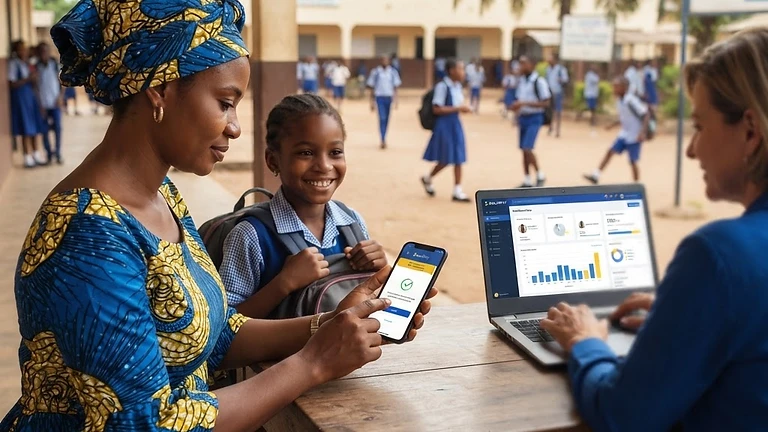
How African Schools Can Simplify Fee Collection with Mobile Money
For many private schools in Francophone Africa, collecting tuition is still a monthly exercise in cash, paper receipts, phone calls, and guesswork. A parent may pay through an agent, send a screenshot on WhatsApp, or hand over cash at the office. The school then has to identify the student, update the balance, issue a receipt, and follow up on unpaid amounts. When several payments arrive at once—or when a family pays in instalments—small errors quickly become big problems.
Mobile money offers a better starting point. Parents in Côte d'Ivoire, Cameroon, Benin, Togo, Chad, and the DRC already use services such as Orange Money, MTN Mobile Money, Moov Money, CamPay, or other local wallets for everyday transactions. The opportunity for schools is not simply to add a payment number. It is to build a complete fee-collection process around digital payments.
Why mobile money is attractive for schools and families
The first benefit is convenience. A parent should not need to lose half a day travelling to a school or bank just to pay an instalment. A mobile transaction can be made from home, work, or a nearby agent. Relatives who help pay school fees can also contribute directly, even when they live in another city or country.
The second benefit is traceability. Cash can be misplaced, counted incorrectly, or recorded late. A digital transaction creates a time, amount, and payer trail. That does not eliminate every risk—schools still need controls—but it makes it easier to answer basic questions: Who paid? For which student? How much remains? Was a receipt issued?
The third benefit is flexibility. Many families do not pay a full term at once. A school system that supports instalments can show the original invoice, every payment, the remaining balance, and the next due date. This is clearer and more respectful than repeated manual reminders with no account history.
A GSMA case study on Côte d'Ivoire showed how widely mobile money can be used for school registration payments. Research and field experience also show that adoption depends on the school's operating systems—not only on whether parents own a mobile phone.
The five pieces of a dependable system
1. Give every student a clear reference. Use a unique student number or invoice reference. Parents should include it with each payment, and staff should be able to search it quickly. Names alone are risky when several students share a surname.
2. Issue invoices before requesting payment. An invoice should state the student, class, academic year, fee type, amount due, due date, and accepted payment channels. If uniforms, meals, transport, or exam fees are separate, show them as separate lines. Clarity reduces disputes.
3. Reconcile payments every day. Do not rely on screenshots as the official record. Import or review transactions, match them to references, flag exceptions, and confirm the updated balance. A short daily routine is safer than trying to reconstruct the whole month later.
4. Send an immediate receipt. Once a payment is matched, the parent should receive a receipt by the channel the school actually uses—email, SMS, WhatsApp, or a downloadable document. The receipt should include the amount received, transaction date, reference, and balance remaining.
5. Protect access and personal data. Staff should use individual accounts with appropriate roles. A teacher does not need the same permissions as a bursar or school administrator. Payment functions and integrations should verify authorized users, while public payment links should use secure, time-limited references rather than exposing student data.
How to introduce mobile payments without excluding families
A sudden switch can frustrate parents who are unfamiliar with digital payments or who have limited connectivity. Start with a short pilot—one campus, grade, or fee type. Publish simple instructions in French and local languages where appropriate. Demonstrate one payment at a parent meeting, keep a staffed help channel during the first weeks, and offer a temporary assisted-payment option.
Schools should also publish the exact fees charged by each channel. Parents need to know whether the school absorbs the transaction cost or whether it is added to the payment. Never ask families to send money to an employee's personal wallet when a safer institutional process is available.
Finally, measure more than total money collected. Track the percentage of payments automatically matched, average time to issue a receipt, unresolved exceptions, overdue balances, and support requests. These indicators show whether the system is genuinely reducing work.
A practical checklist for administrators
Before launch, confirm that your school can answer yes to these questions:
- Does every invoice have a unique student or payment reference?
- Can the bursar see paid, partially paid, and overdue balances in one place?
- Are receipts generated consistently after reconciliation?
- Are user roles, backups, and approval rules defined?
- Can parents get help when a payment is delayed or incorrectly referenced?
Mobile money is not a substitute for sound financial administration. It is the transaction layer. The real improvement comes when payments, invoices, student records, receipts, reminders, and reports work together.
SkolarPay helps schools bring those steps into one organized workflow, so administrators spend less time searching through notebooks and messages and more time supporting their school community. If your school is ready to test a clearer fee process, start with one payment cycle, measure the results, and expand from there.
Get more tips for managing your school
Subscribe to receive our best articles on school management and fee collection.